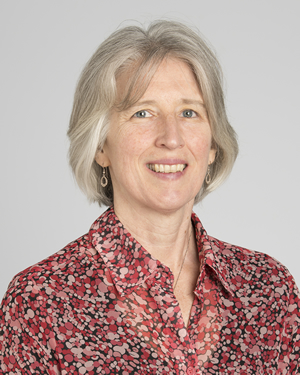
Kathleen Derwin, PhD
Department Vice Chair
Associate Staff, Biomedical Engineering
Co-Director, Musculoskeletal Research Center
Vice Chair, Innovation Management and Conflict of Interest
Email: [email protected]
Location: Cleveland Clinic Main Campus
Research
Dr. Derwin’s research focuses on improving the understanding and outcomes of rotator cuff pathology and repair (RCR). Early work established canine models of rotator cuff injury and repair, providing controlled systems to evaluate tendon healing, scaffold-based augmentation, and surgical techniques, including the characterization of “failure with continuity.”
Recognizing the limitations of animal models, she transitioned to human clinical research, leading prospective, NIH-funded longitudinal studies of patients undergoing RCR. These studies integrate imaging, functional assessments, and patient-reported outcomes (PROMs) to quantify repair integrity, tendon and muscle pathology, and factors influencing clinical recovery.
Her work also includes scaffold-based augmentation for rotator cuff and ventral hernia repair, with standardized laboratory tests and multiple patented and licensed extracellular matrix technologies. Overall, her research combines biomechanical, biological, and clinical data to provide evidence on repair outcomes and inform strategies to improve healing and patient recovery.
Biography
Kathleen A. Derwin, PhD, is Vice Chair and Associate Staff in the Department of Biomedical Engineering at Cleveland Clinic’s Lerner Research Institute and in Orthopaedic Surgery at Cleveland Clinic. She also serves as Director of the Musculoskeletal Research Center and holds academic appointments at Case Western Reserve University and Cleveland State University. For more than 25 years, she has led the Cleveland Clinic Shoulder Research Program and made seminal contributions to rotator cuff research, spanning basic, translational, and clinical investigation.
Education & Professional Highlights
Appointed to Cleveland Clinic Staff: 1998
- Bachelor of Science, Mechanical Engineering – University of Massachusetts at Amherst (1989)
- Master of Science, Bioengineering – University of Michigan, Ann Arbor (1991)
- Master of Science in Engineering, Mechanical Engineering – University of Michigan, Ann Arbor (1992)
- PhD – University of Michigan, Ann Arbor, MI (1997)
25 years of research and academic appointments at Cleveland Clinic
- $13M in extramural direct funding (NIH and other sources)
- ~90 peer-reviewed publications (H-index 34)
- 7 book chapters; 9 issued U.S. patents; 3 commercial licenses
- Conducted human longitudinal studies of rotator cuff repair
- Developed and applied clinical research methods integrating imaging, functional assessment, and patient-reported outcomes
- Active industry collaborations
Inducted into the American Shoulder and Elbow Surgeons (2010)
Elected Fellow of the Orthopaedic Research Society (2023)
Research
Our research program investigates factors influencing healing and clinical outcomes after rotator cuff repair (RCR), including patient demographics, disease characteristics, surgical techniques, and local biological factors such as stem and progenitor cells and inflammatory biomarkers. Ongoing projects, including NIH- and industry-supported studies, aim to identify modifiable factors that can guide clinical decision-making, inform patient selection, and improve repair outcomes.
We also study extracellular matrix scaffold technologies as a surgical strategy to enhance tendon healing. This work includes both translational and clinical studies evaluating scaffold performance, tendon retraction using MRI and novel CT-based imaging, and the relationship between structural repair and functional outcomes. Additional efforts focus on imaging biomarkers and local bone marrow characteristics to support decisions about regenerative therapies and tissue-healing potential.
Our Team
Selected Publications
View publications for Kathleen Derwin, PhD
(Disclaimer: This search is powered by PubMed, a service of the U.S. National Library of Medicine. PubMed is a third-party website with no affiliation with Cleveland Clinic.)
- Sahoo Sambit, Li Yadi, Cogan Charles J, Entezari Vahid, Ho Jason C, Iannotti Joseph P, Ricchetti Eric T, Lapin Brittany, Derwin Kathleen A. Comparative Responsiveness of Shoulder PROMs to Rotator Cuff Repair Surgery and Healing. J Shoulder Elbow Surg. 2026. 41720252.
- Sahoo Sambit, Li Yadi, Cogan Charles J, Entezari Vahid, Ho Jason C, Iannotti Joseph P, Ricchetti Eric T, Derwin Kathleen A, Lapin Brittany. Measurement properties of patient-reported outcome measures for rotator cuff repair surgery. J Shoulder Elbow Surg. 2026. 40902711.
- Derwin Kathleen A. Association between osteoporosis and rotator cuff tears: evidence from causal inference and colocalization analyses. Bone Res. 2025. 40866365.
- Yang Mingrui, Jun Bong-Jae, Owings Tammy, Subhas Nikhil, Polster Joshua, Winalski Carl S, Ho Jason C, Entezari Vahid, Derwin Kathleen A, Ricchetti Eric T, Li Xiaojuan. Automated 3D segmentation of rotator cuff muscle and fat from longitudinal CT for shoulder arthroplasty evaluation. Skeletal Radiol. 2026. 40782188.
- Sahoo Sambit, Imrey Peter B, Jin Yuxuan, Cogan Charles J, Entezari Vahid, Ho Jason C, Iannotti Joseph P, Ricchetti Eric T, Derwin Kathleen A. Predictors of patient-reported outcomes after primary arthroscopic rotator cuff repair. J Shoulder Elbow Surg. 2026. 40490070.
- Khan Shujaa T, Huffman Nick, Li Xiaojuan, Sharma Anukriti, Winalski Carl S, Ricchetti Eric T, Derwin Kathleen, Apte Suneel S, Rotroff Daniel, Saab Carl Y, Piuzzi Nicolas S. Pain Assessment in Osteoarthritis: Present Practices and Future Prospects Including the Use of Biomarkers and Wearable Technologies, and AI-Driven Personalized Medicine. J Orthop Res. 2025. 40205648.
- Patel Midhat, Cogan Charles J, Sahoo Sambit, Owings Tammy M, Ma Jinjin, Shemo Catherine, Baker Andrew, Jun Bong Jae, Iannotti Joseph P, Ho Jason C, Ricchetti Eric T, Derwin Kathleen A, Entezari Vahid. Postoperative patient-reported outcomes and radiographic findings do not significantly change between 1 and 2 years postoperatively after primary anatomic shoulder arthroplasty. J Shoulder Elbow Surg. 2025. 40057175.
- Derwin Kathleen A, Dweik Raed. Conflicts of Interest in Clinical Practice: Cleveland Clinic Policy and Experience. J Law Med Ethics. 2024. 39676368.
- Sahoo Sambit, Entezari Vahid, Ho Jason C, Jun Bong-Jae, Jin Yuxuan, Imrey Peter B, Derwin Kathleen A, Iannotti Joseph P, Ricchetti Eric T. Disease diagnosis and arthroplasty type are strongly associated with short-term postoperative patient-reported outcomes in patients undergoing primary total shoulder arthroplasty. J Shoulder Elbow Surg. 2024. 38430979.
- Ho Jason C, Derwin Kathleen. Is 3D Quantitative MRI the Next Tool to Evaluate Rotator Cuff Musculature and Other Muscle Pathology?: Commentary on an article by Junjie Xu, MD, PhD, et al.: "Longitudinal Changes in Overall 3D Supraspinatus Muscle Volume and Intramuscular Fatty Infiltration After Arthroscopic Rotator Cuff Repair". J Bone Joint Surg Am. 2024. 38323991.
- Sahoo Sambit, Derwin Kathleen A, Jin Yuxuan, Imrey Peter B, Ricchetti Eric T, Entezari Vahid, Iannotti Joseph P, Spindler Kurt P, Ho Jason C. One-year patient-reported outcomes following primary arthroscopic rotator cuff repair vary little by surgeon. JSES Int. 2023. 37426918.
- McConaghy Kara, Klika Alison K, Apte Suneel S, Erdemir Ahmet, Derwin Kathleen, Piuzzi Nicolas S. A Call to Action for Musculoskeletal Research Funding: The Growing Economic and Disease Burden of Musculoskeletal Conditions in the United States Is Not Reflected in Musculoskeletal Research Funding. J Bone Joint Surg Am. 2023. 36574617.
- Basdavanos Alyssa, Maurer Mathew S, Ives Lauren, Ricchetti Eric T, Seitz William, Hanna Mazen. Prevalence of Orthopedic Manifestations in Patients With Cardiac Amyloidosis With a Focus on Shoulder Pathologies. Am J Cardiol. 2023. 36566619.
- Ma Jinjin, Sahoo Sambit, Imrey Peter B, Jin Yuxuan, Baker Andrew R, Entezari Vahid, Ho Jason C, Schickendantz Mark S, Farrow Lutul D, Serna Alfred, Iannotti Joseph P, Ricchetti Eric T, Polster Joshua M, Winalski Carl S, Derwin Kathleen A. Agreement between intraoperative and magnetic resonance imaging assessments of rotator cuff pathology and 2 magnetic resonance imaging-based assessments of supraspinatus muscle atrophy. JSES Int. 2022. 36353424.
- Sahoo Sambit, Rodríguez José A, Serna Matthew, Spindler Kurt P, Derwin Kathleen A, Iannotti Joseph P, Ricchetti Eric T. Effectiveness of a Web-Based Electronic Prospective Data Collection Tool for Surgical Data in Shoulder Arthroplasty. Semin Arthroplasty. 2021. 34690468.
- Sahoo Sambit, Stojanovska Martina, Imrey Peter B, Jin Yuxuan, Bowles Richard J, Ho Jason C, Iannotti Joseph P, Ricchetti Eric T, Spindler Kurt P, Derwin Kathleen A, Entezari Vahid. Changes From Baseline in Patient- Reported Outcomes at 1 Year Versus 2 Years After Rotator Cuff Repair: A Systematic Review and Meta-analysis. Am J Sports Med. 2022. 34473586.
- Iannotti Joseph P, Jun Bong-Jae, Derwin Kathleen A, Ricchetti Eric T. Stepped Augmented Glenoid Component in Anatomic Total Shoulder Arthroplasty for B2 and B3 Glenoid Pathology: A Study of Early Outcomes. J Bone Joint Surg Am. 2021. 33989252.
- Ma Jinjin, Sahoo Sambit, Imrey Peter B, Jin Yuxuan, Baker Andrew R, Entezari Vahid, Ho Jason C, Iannotti Joseph P, Ricchetti Eric T, Polster Joshua M, Winalski Carl S, Derwin Kathleen A. Inter-rater agreement of rotator cuff tendon and muscle magnetic resonance imaging parameters evaluated preoperatively and during the first postoperative year following rotator cuff repair. J Shoulder Elbow Surg. 2021. 33930556.
Patents
| US Patent | Patent Title | Issue Date | First-Named Inventor |
|---|---|---|---|
| US 8,080,260 | Molecular Enhancement of Extracellular Matrix and Methods of Use | ||
| US 10,004,586 | Biocompatible Tissue Graft | ||
| US 9,265,524 | Devices and Methods of Use for Tissue Graft Delivery | ||
| US 10,758,644 | Reinforced Tissue Graft | ||
| US 11,013,590 | Reinforced Tissue Graft | ||
| US 11,413,112 B2 | Radiopaque Tissue Marker |
Research News

Teams of physicians and researchers receive funding to pursue new approaches to solving problems in patient care.

The new grant supports a multi-center, randomized clinical trial exploring a new surgical technique, Bridge-Enhanced® ACL Repair (BEAR®).